
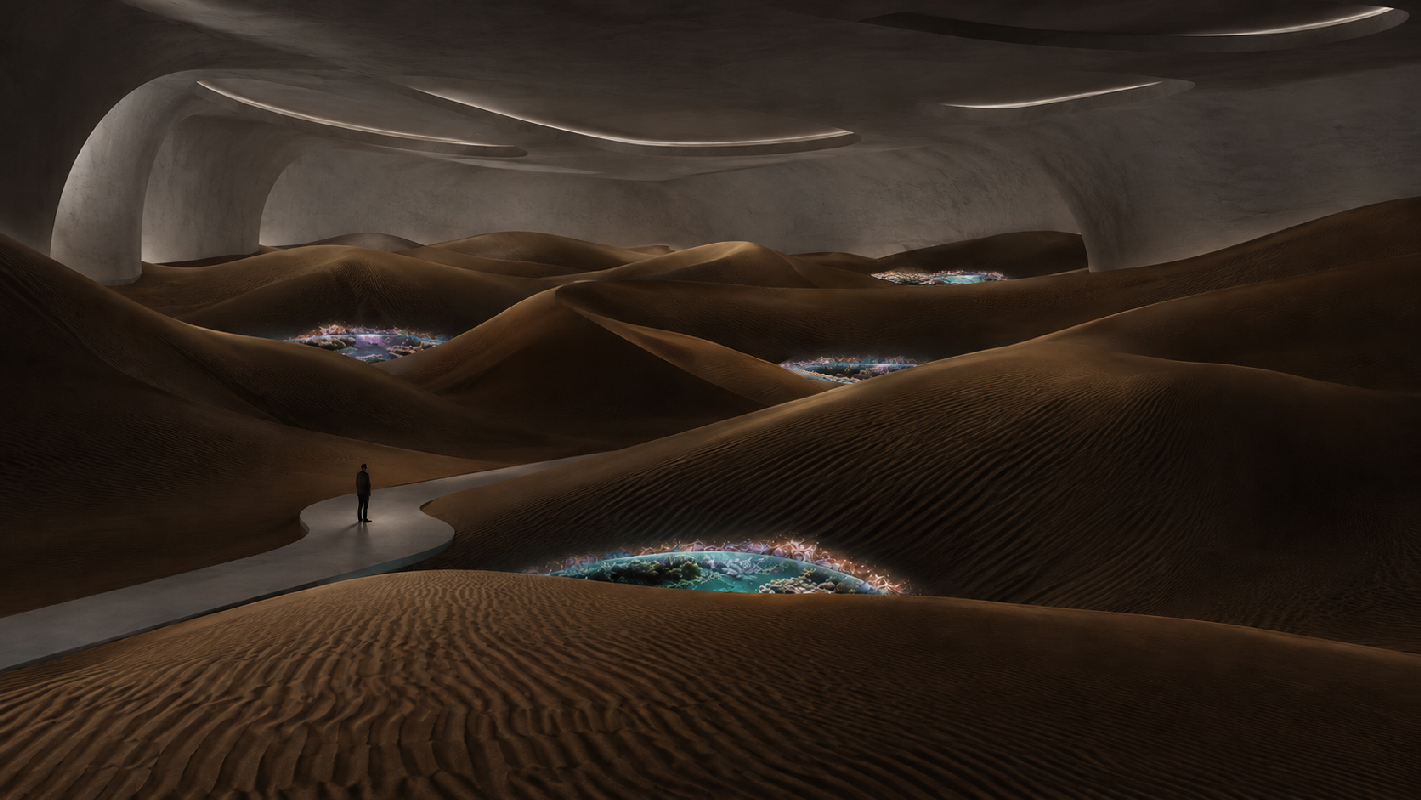
The research conducted by physicist Pierre-Gilles de Gennes into soft matter and granular materials helped reveal the paradoxical behaviour of sand: it can resist like a solid, flow like a liquid, disperse, or collapse under the slightest disturbance. This ordinary material therefore eludes stable categories. Though seemingly motionless, it remains traversed by invisible tensions, movements and forces. Natural in origin yet transformed through extraction and industrial use, sand already stands at the threshold between geological processes and human intervention.
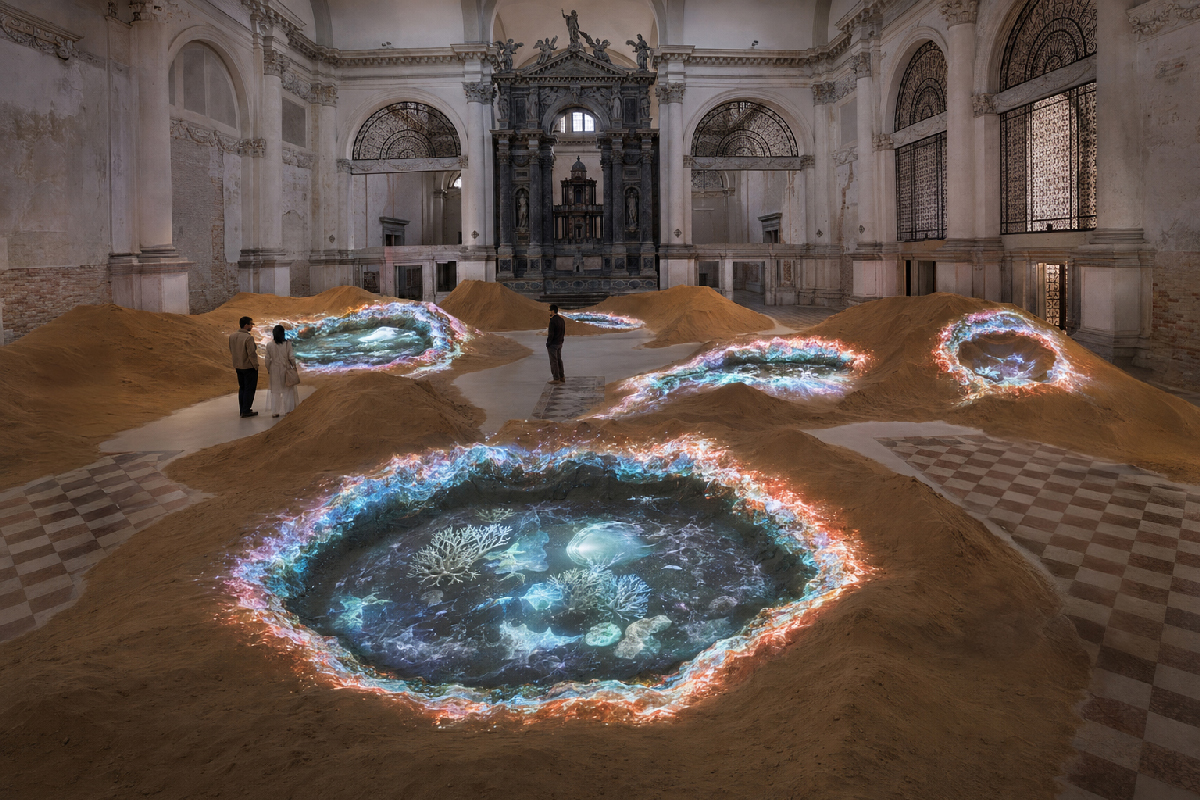
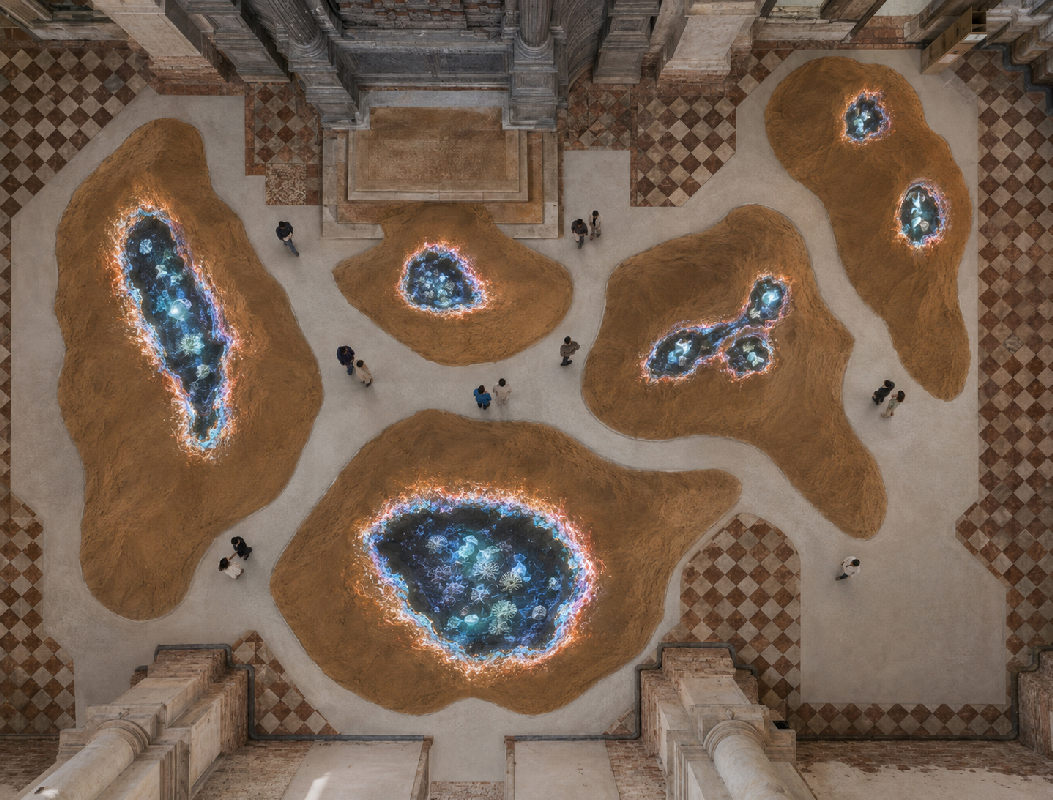
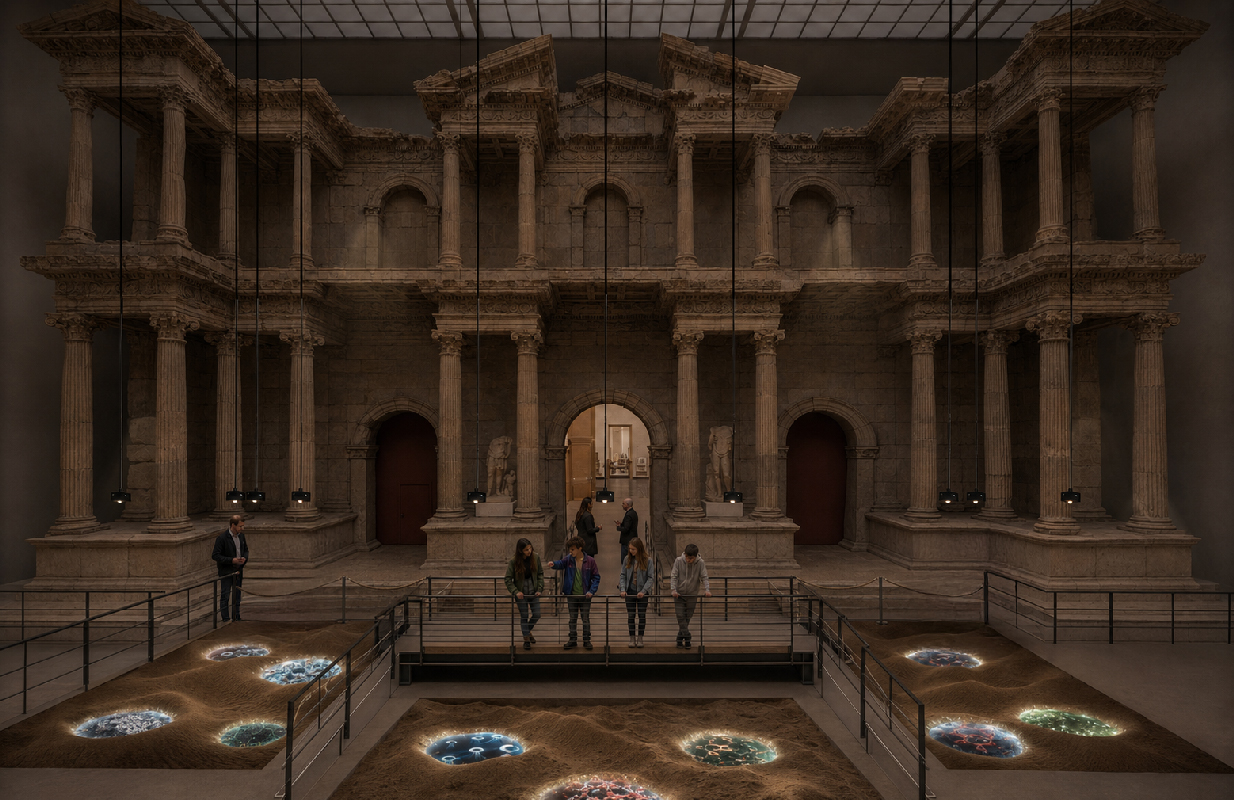
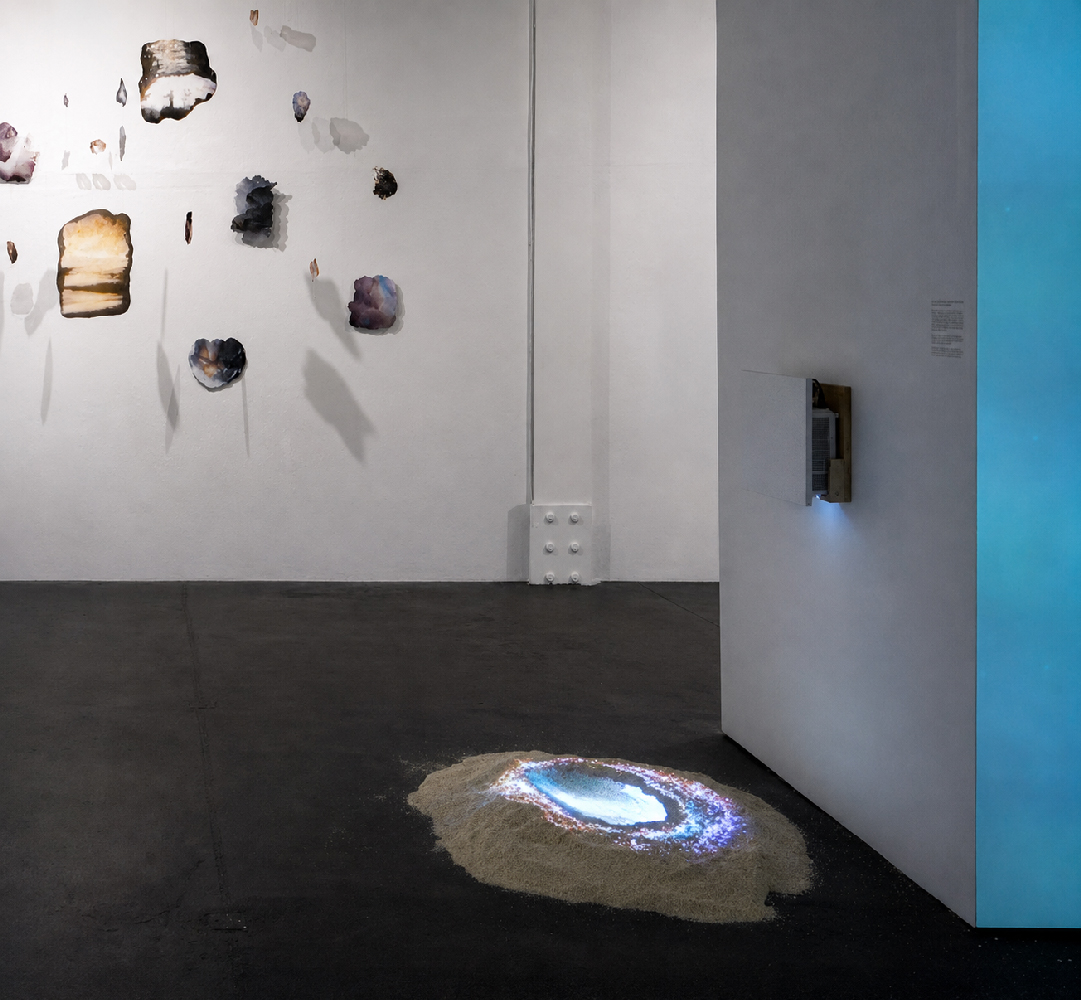
INTRUSION N°2-26 takes this instability as its point of departure. A landscape of sand appears to have passed through the architecture. Mountains, dunes, valleys, faults and craters occupy the space like fragments emerging from an unknown geology. Yet this territory is neither desert nor extraterrestrial. Within its depths appear images of our own world: ocean currents, plastic matter, bleached coral, shifting ice formations and fragile ecosystems.
Here, the artificial no longer exists outside the living world. It penetrates its environments, circulates through its flows and is gradually incorporated into its organisms. Microplastics present in water, soil, air and bodies; chemical substances absorbed by biological tissues; industrial materials that have become almost inseparable from ecosystems: human activity no longer merely alters landscapes. It now participates—often irreversibly—in their very composition.
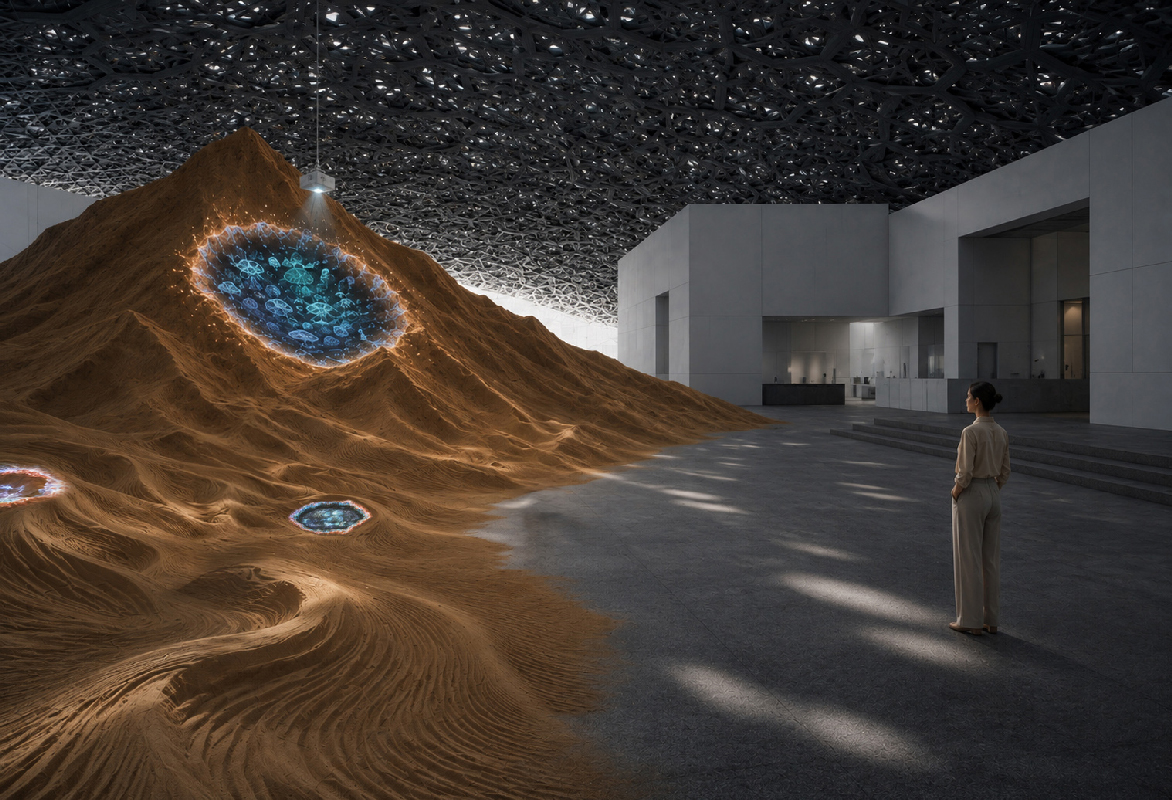
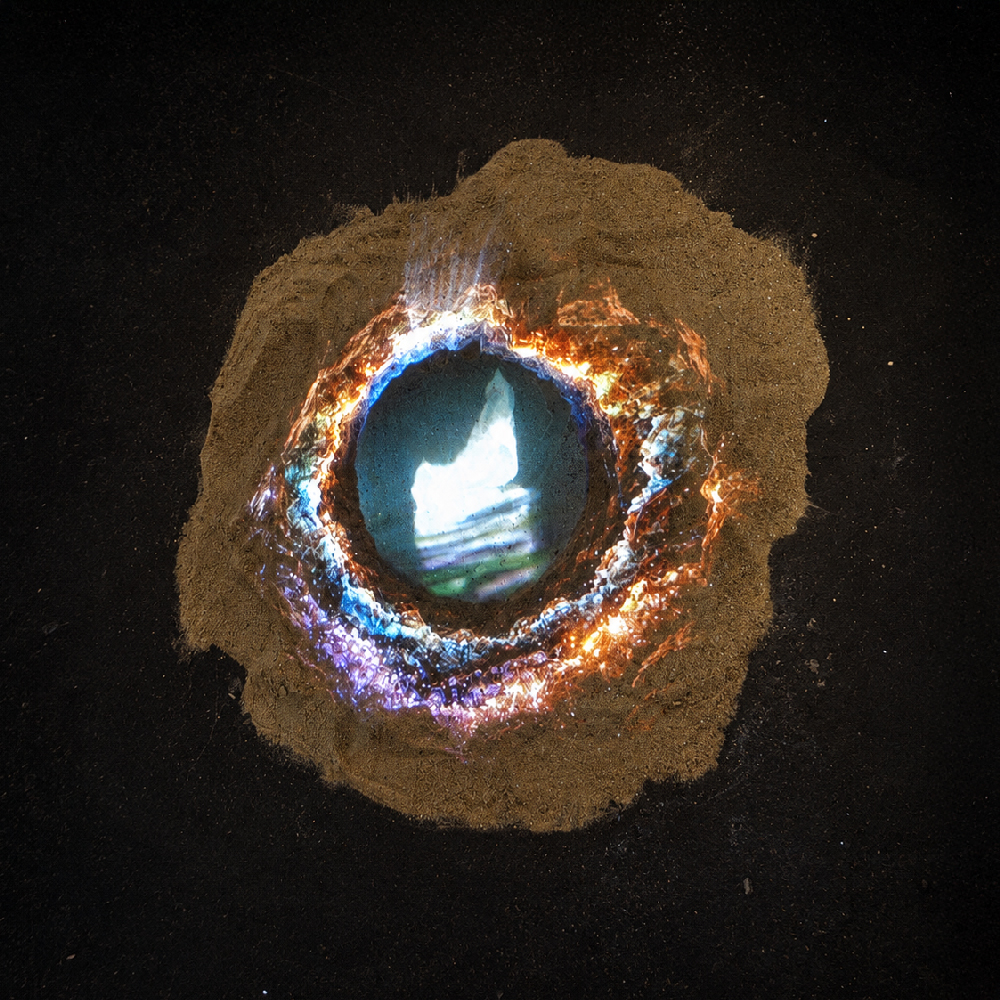
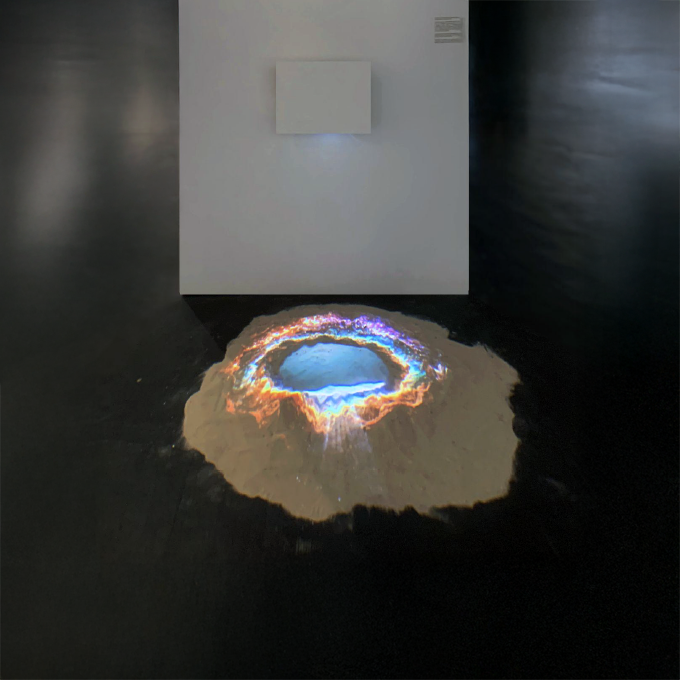
The installation overturns our habitual position in relation to representations of the ecological crisis. What we generally keep at a distance—pollution, global warming, resource depletion and species extinction—no longer appears as an image framed by a screen or absorbed into the continuous flow of information. The projection is inscribed directly into matter, following its contours and opening breaches at the heart of the landscape. It seeps into the sand and appears to rise from its depths, as though the Earth itself were revealing the transformations that our societies still seek to bury, abstract or render invisible.
Sand occupies a paradoxical position within the work. It evokes time, deserts, beaches, erosion and the slow formation of territories. Yet it is also one of the resources most extensively extracted and consumed by global industry. Both a natural element and a construction material, it connects geological movements to human architecture, coastal ecosystems to contemporary cities. Its apparent fragility contrasts with the monumentality of the installation, while its instability reminds us that no landscape, equilibrium or territory is ever permanently fixed.
Each crater becomes both an observational device and a zone of rupture. It opens up a critical space in which terrestrial, biological, industrial and technological phenomena emerge as interdependent components of the same transformation. The visitor no longer contemplates the environment from the outside. They move among the landforms, navigate around the faults, alter their route, slow down and accept sharing the space with a material that resists control.
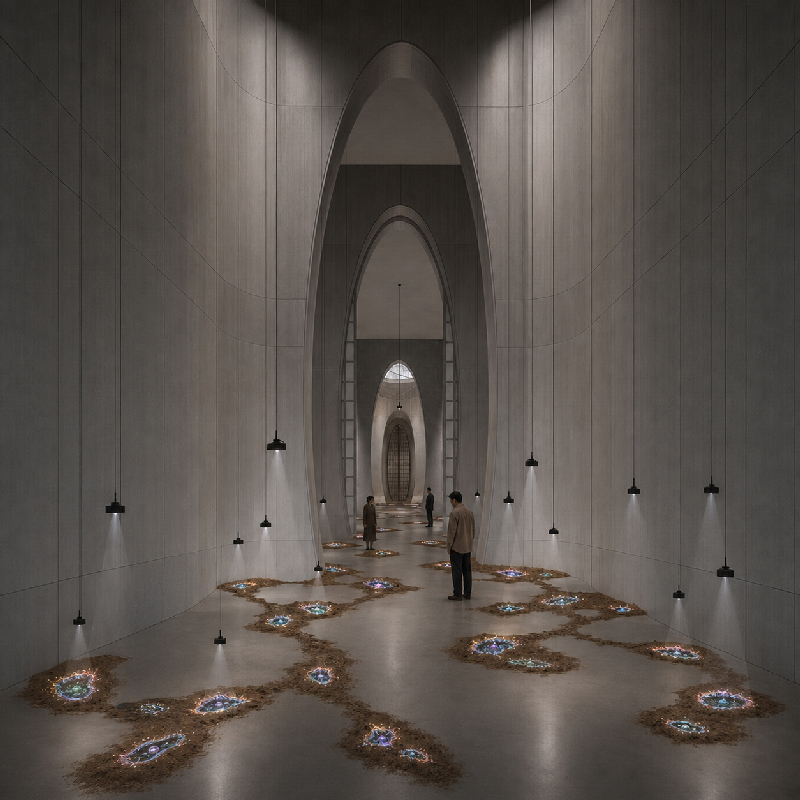
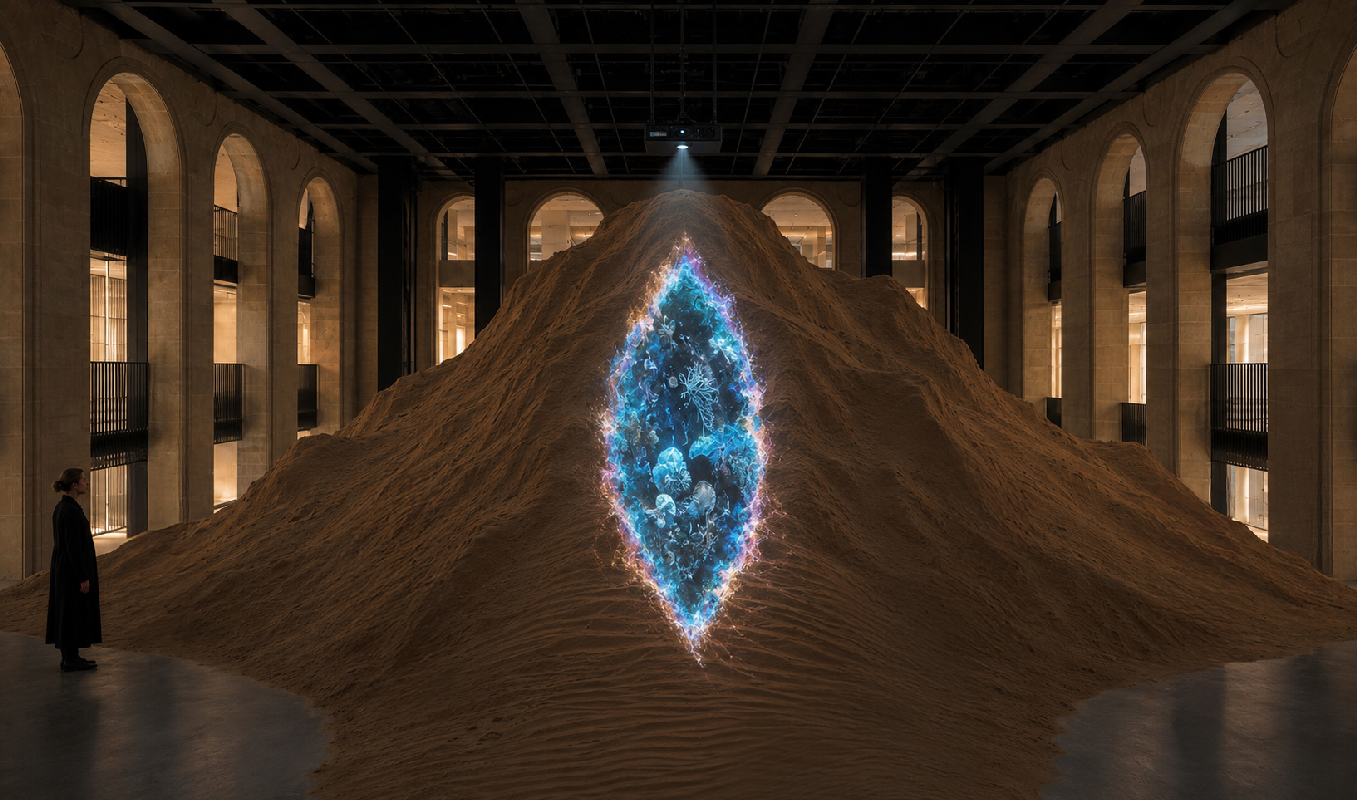
INTRUSION N°2-26 can assume different configurations according to the scale and architecture of its host site. A single crater, video-projected onto the summit of a mountain of sand, focuses attention on a central wound that is both monumental and almost ceremonial. The crisis becomes a visible yet difficult-to-reach summit, simultaneously generating a sense of the sublime, fascination and human smallness.
A succession of craters, by contrast, creates a journey. Each opening becomes a chapter within a broader transformation, revealing connections between phenomena that we too often perceive in isolation. Other craters may remain concealed within the valleys: their intimate and gradual discovery evokes the silent mutations that develop before becoming irreversible.
A constellation of microcraters produces yet another experience. The crisis no longer possesses an identifiable centre: it spreads, proliferates and reappears at every scale. Pollution becomes almost cellular, constituting a form of anthropogenic colonisation of environments in which no single site can be considered in isolation. This proliferation demands sustained attention from the visitor while confronting them with the impossibility of grasping the phenomenon in its entirety.
These scenographic variations are therefore more than formal adaptations: they transform and expand the meaning of the work itself. The single crater evokes an event, a wound and a tipping point. A pathway through several faults connects interdependent phenomena. The multiplication of cavities makes visible a diffuse, networked form of contamination that is difficult to contain. Craters positioned at the summit become signals; those concealed within valleys remain silent revelations. When only their edges are projected, the fault becomes an unstable threshold between appearance and disappearance, surface and depth, nature and artifice, the living and the non-living.
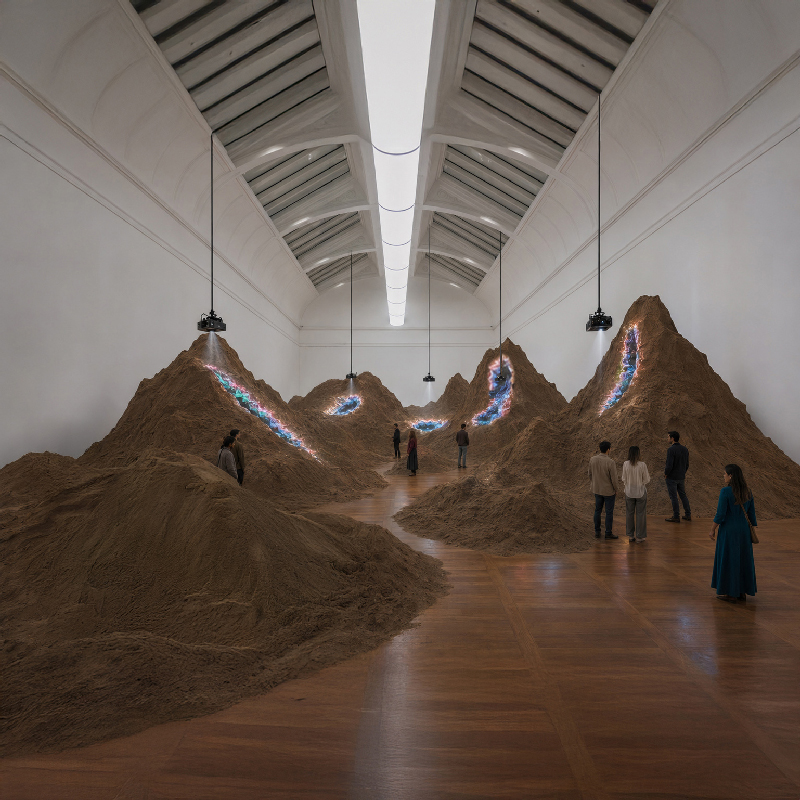
INTRUSION N°2-26 does not present the spectacular image of a world after catastrophe. Instead, the installation renders perceptible a process already underway: the involuntary hybridisation of life with the material, chemical and technological residues produced by human activity. It places us upon an unstable threshold—between fascination and unease, contamination and adaptation, collapse and the possibility of repair.
Following Donna Haraway’s thinking, the work seeks neither to simplify the crisis nor to position us outside the world that produced it. It invites us to “stay with the trouble”: to inhabit the now irreducible entanglement of nature and artifice, to observe what persists within altered environments, to recognise the interdependencies that constitute us, and to imagine—from within these transformations—other ways of composing with the living world.
Les recherches du physicien Pierre-Gilles de Gennes sur la matière molle et les milieux granulaires ont contribué à révéler le comportement paradoxal du sable : il peut résister comme un solide, s’écouler comme un liquide, se disperser ou s’effondrer sous l’effet d’une perturbation minime. Cette matière ordinaire échappe ainsi aux catégories stables. Apparemment immobile, elle demeure traversée par des tensions, des déplacements et des forces invisibles. Naturelle par son origine, artificialisée par son extraction et ses usages industriels, elle se situe déjà à la frontière entre processus géologiques et transformations humaines.
INTRUSION N°2-26 prend cette instabilité comme point de départ. Un paysage de sable semble avoir traversé l’architecture. Montagnes, dunes, vallées, failles et cratères occupent l’espace comme les fragments émergés d’une géologie inconnue. Pourtant, ce territoire n’est ni désertique ni extraterrestre. Dans ses profondeurs apparaissent les images de notre propre monde : courants océaniques, matières plastiques, coraux blanchis, glaces en transformation et écosystèmes fragilisés.
L’artificiel n’est plus ici extérieur au vivant. Il pénètre ses milieux, circule dans ses flux et s’incorpore progressivement à ses organismes. Microplastiques présents dans l’eau, les sols, l’air et les corps ; substances chimiques absorbées par les tissus biologiques ; matériaux industriels devenus presque indissociables des écosystèmes : l’activité humaine ne se contente plus de modifier les paysages. Elle participe désormais, souvent de manière irréversible, à leur composition.
L’installation renverse notre position habituelle face aux représentations de la crise écologique. Ce que nous maintenons généralement à distance — pollution, réchauffement climatique, épuisement des ressources, disparition des espèces — ne se présente plus comme une image cadrée par un écran ou absorbée dans le flux continu de l’information. La projection s’inscrit directement dans la matière, épouse ses reliefs et ouvre des brèches au cœur du paysage. Elle s’insinue dans le sable et semble remonter de ses profondeurs, comme si la Terre révélait les transformations que nos sociétés cherchent encore à enfouir, à abstraire ou à rendre invisibles.
Le sable occupe ici une position paradoxale. Il évoque le temps, le désert, les plages, l’érosion et la lente formation des territoires. Mais il est également l’une des ressources les plus massivement extraites et consommées par l’industrie mondiale. Élément naturel et matériau de construction, il relie les mouvements géologiques aux architectures humaines, les écosystèmes littoraux aux métropoles contemporaines. Sa fragilité apparente contraste avec la monumentalité de l’installation, tandis que son instabilité rappelle qu’aucun paysage, aucun équilibre et aucun territoire ne sont définitivement fixés.
Chaque cratère devient un dispositif d’observation autant qu’une zone de basculement. Il ouvre un espace critique dans lequel les phénomènes terrestres, biologiques, industriels et technologiques apparaissent comme les composantes interdépendantes d’une même transformation. Le visiteur ne contemple plus l’environnement depuis l’extérieur. Il circule entre les reliefs, contourne les failles, modifie son itinéraire, ralentit et accepte de partager l’espace avec une matière qui résiste à sa maîtrise.
INTRUSION N°2-26 peut adopter différentes configurations selon l’échelle et l’architecture du lieu qui l’accueille. Un cratère unique, projeté au sommet d’une montagne de sable, concentre l’attention sur une blessure centrale, monumentale et presque cérémonielle. La crise devient un sommet visible, mais difficilement accessible : elle produit simultanément un sentiment de sublime, de fascination et de petitesse.
Une succession de cratères construit au contraire un parcours. Chaque ouverture devient le chapitre d’une transformation plus vaste et révèle les relations entre des phénomènes que nous percevons trop souvent séparément. D’autres cratères peuvent demeurer dissimulés dans les vallées : leur découverte intime et progressive évoque les mutations silencieuses qui se développent avant de devenir irréversibles.
Une constellation de microcratères produit encore une autre expérience. La crise ne possède plus de centre identifiable : elle se diffuse, prolifère et réapparaît à toutes les échelles. La pollution devient presque cellulaire, constituant une forme de colonisation anthropique des milieux dans laquelle aucun foyer ne peut être considéré isolément. Cette multiplication impose au visiteur une attention soutenue tout en lui faisant éprouver l’impossibilité de tout embrasser.
Ces variations scénographiques ne constituent donc pas de simples adaptations formelles : elles transforment et déploient le sens même de l’œuvre. Le cratère unique évoque l’événement, la blessure et le point de bascule. Le parcours de plusieurs failles met en relation des phénomènes interdépendants. La multiplication des cavités rend visible une contamination diffuse, réticulaire et difficile à circonscrire. Les cratères placés au sommet deviennent des signaux ; ceux dissimulés dans les vallées demeurent des révélations silencieuses. Lorsque seule leur bordure est projetée, la faille devient un seuil instable entre apparition et disparition, surface et profondeur, nature et artifice, vivant et non-vivant.
INTRUSION N°2-26 ne propose pas l’image spectaculaire d’un monde après la catastrophe. L’installation rend perceptible un processus déjà engagé : l’hybridation involontaire du vivant avec les résidus matériels, chimiques et technologiques produits par l’activité humaine. Elle nous place sur une frontière instable, entre fascination et inquiétude, contamination et adaptation, effondrement et possibilité de réparation.
Dans le prolongement de la pensée de Donna Haraway, l’œuvre ne cherche ni à simplifier la crise ni à nous placer hors du monde qui l’a produite. Elle nous invite à « rester avec le trouble » : à habiter cette confusion devenue irréductible entre nature et artifice, à observer ce qui persiste dans les milieux altérés, à reconnaître les interdépendances qui nous constituent et à imaginer, depuis l’intérieur même des transformations, d’autres manières de composer avec le vivant.
Nouvelles formes d’écologie du vivant et architectures relationnelles
New Forms of Living Ecology and Relational Architectures
Meta description :
INTRUSION N°2-26 is a scalable sand and video installation exploring living ecologies, plastic pollution and the entanglement of nature and artifice.
INTRUSION N°2-26, trompe-l’œil video projection mapped onto sand, 100ecs, Paris, 2026.